Kali Motor Group Search


- All
- Product Management
- News
- Introduction
- Enterprise outlets
- FAQ
- Enterprise Video
- Enterprise Atlas
5G base station
Release time:2020-03-27
5G is the fifth generation of communication technology, the main features are millimeter wavelength, ultra-wideband, ultra-high speed, ultra-low delay. 1G realizes analog voice communication, mobile phone has no screen and can only make phone calls; 2G has realized the digitization of voice communication, and the function machine has a small screen to send short messages. 3G realizes multimedia communication of pictures other than voice, and the screen becomes larger to see pictures. 4G has realized local high-speed Internet access. Large-screen smart machines can watch short videos, but the signal is good in cities and poor in rural areas. 1G ~ 4G all focus on more convenient and fast communication between people, and 5G will realize the interconnection of everything anytime, anywhere, so that human beings dare to expect to participate in it simultaneously with everything on the earth through live broadcast.
The arrival of the 5G era, Massive the introduction of MIMO technology, directly led to the development of 5G base station antenna three trends:
1) passive antenna to active antenna development;
2) fiber replacement feeder;
3) RRH (Radio Remote Head) and antenna are partially integrated.
With the continuous evolution of communication networks to 5G, display antennas (multi-antenna space division multiplexing), multi-beam antennas (network densification) and multi-band antennas (spectrum expansion) will become the main types of future base station antenna development.
With the advent of 5G networks, the needs of major operators for mobile networks are constantly changing. In order to achieve full network coverage, more and more types of base station electrically adjustable antennas are widely used in the field of mobile communications. For the four-frequency antenna, in order to realize the control of its electronic down-tilt angle, there are mainly three kinds of electronic adjustment control devices, including the combination of two built-in dual-electric electromechanical adjustment controllers, the dual-electric electromechanical adjustment controller with transmission switching mechanism, and the four built-in motor electronic adjustment controllers. It can be seen that no matter which device is used, it is inseparable from the application of the antenna motor.
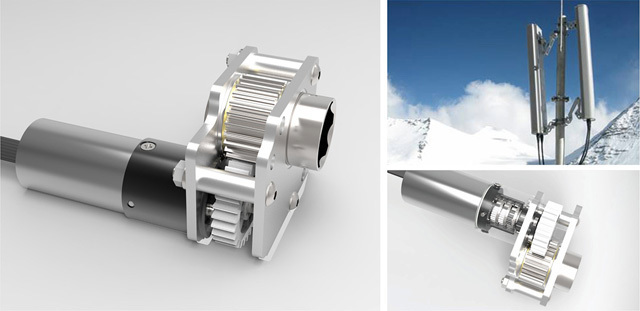
The main structure of the base station electric antenna motor is a motor-reducer integrated machine assembled by a transmission motor and a reduction gear box, which has the function of reduction adjustment. The transmission motor provides output speed and low torque rotation speed. The gear box is connected to the transmission motor to reduce the output speed of the transmission motor and at the same time increase the torque to achieve the ideal transmission effect. Base station electric antenna motor gearbox usually adopts customized motor gearbox technical parameters, power and performance, better meet the environment, climate, temperature and other environmental factors, to achieve the ideal transmission effect and service life requirements.
Previous
Next
Previous
Next
Social Media