Kali Motor Group Search


- All
- Product Management
- News
- Introduction
- Enterprise outlets
- FAQ
- Enterprise Video
- Enterprise Atlas
Nie Pengju, a representative of the National People's Congress: It is recommended to support the core parts industry of industrial robots.
Release Time:2020-05-19
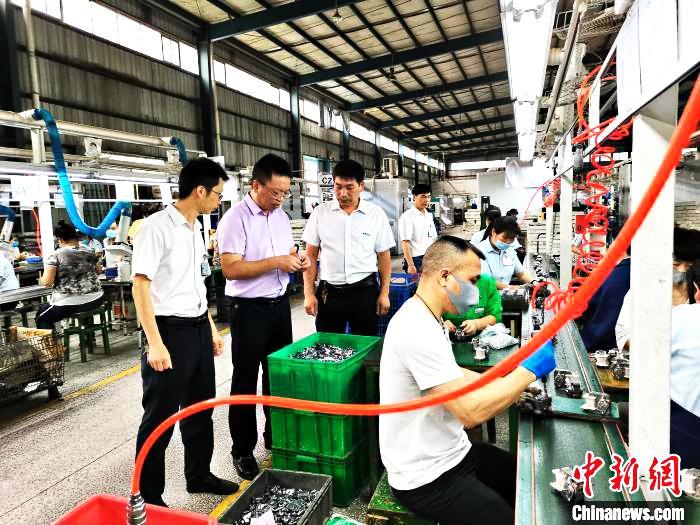
Nie Pengju learned about the resumption of work and production at the Qiyang factory in Kolier Hunan.
"It is suggested that the state should focus on supporting and cultivating benchmark innovation enterprises in the three core components industry of industrial robots, promote the development of the industry towards the middle and high end, and make the product technology and quality level reach or exceed the international advanced level." In 2020, the National People's Congress will be held soon. Nie Pengju, deputy to the National People's Congress and chairman of Kolier Electric Group Co., Ltd., is concerned about the development of industrial robots in China.
With the continuous development of China's social economy, the labor cost of manufacturing industry is rising rapidly, the contradiction between supply and demand is prominent, enterprises are in urgent need of transformation and upgrading, and industrial robots are more and more applied in the intelligent transformation of domestic manufacturing industry. According to data from the International Federation of Robotics, China has become the world's largest consumer market for industrial robots for 6 consecutive years (currently accounting for about 1/3 of the global market), and is still growing rapidly at a rate of more than 20%.
"Industrial robots integrate cutting-edge technologies in materials, electronics, software, manufacturing and other disciplines, and require high investment in talents, technology and capital. It is the most representative product in the field of intelligent manufacturing and a kind of national scientific and technological strength and level. symbol." Nie Pengju found in the survey that compared with Japan, Europe and the United States and other developed countries, China's industrial robot industry has bottlenecks such as weak independent innovation ability, lack of core talents and core technology, and high-end core components are seriously controlled by people.
Industrial robots are mainly used in welding, spraying, handling, assembly, cutting and other fields. Controllers, servo systems and precision reducers are the three core components with the greatest technical difficulty. Servo system is the core "heart" of all kinds of robots and precision equipment ". Last year, Nie Pengju led the team to successfully develop the latest generation of servo system integrating servo motor, encoder and servo driver, which can be used in lithium battery equipment, CNC machine tools, electronic processing equipment, robots and industrial automation equipment. The performance of the products has reached the level of Japanese products, breaking the foreign monopoly on the high-end market.
"The core talents and key technologies of the three core components are the biggest bottlenecks restricting the development of China's industrial robots. At the same time, these three core components have high investment, long cycle, slow results, and relatively high thresholds. General companies cannot become bigger and stronger. To improve the level of domestic robot R & D and manufacturing, we must first improve the technology and quality level of the three core components." Nie Pengju suggested that enterprises can cooperate with institutions of higher learning and vocational schools to train targeted high-quality industrial talents, and at the same time build R & D centers with universities and scientific research institutes, aiming at the international frontier and the reality of industrial development, and jointly research and develop and tackle key problems.
At present, China's robot industry has many opportunities in manufacturing, special robots and other applications. With the development of an aging population, medical robots, nursing robots and home robots will have great breakthroughs. It is expected that the demand for industrial robots in the manufacturing industry will exceed by 2020.500000 units. "National industry associations and technical standards associations can be established to increase basic and forward-looking research on software and hardware technology and applications." Nie Pengju believes that if the technology and quality of innovative products with independent intellectual property rights developed by industrial robot enterprises can fully reach the level of foreign advanced benchmark enterprises, and can completely replace the middle and high-end market, with a market share of more than 10%, the state can give enterprises a major special reward of no less than 5 million yuan after evaluation by the expert group.
Nie Pengju has always been concerned about people's livelihood and actively made suggestions and suggestions around the country's economic and social development. During this year's epidemic, he also mobilized the group to Wuhan Jinyintan Hospital, Wuhan Raytheon Mountain Hospital donated a total of 1.0198 million yuan to help Hubei fight the epidemic. On the basis of extensive research on mask manufacturers, Nie Pengju also submitted "Recommendations on Rapidly Increasing Mask Production Capacity" through the State Council's "Internet Supervision" platform, calling for the introduction of fully automated production lines for masks in key areas of the epidemic to ensure supply, and encouraging enterprises to invest in the production of masks across industries.
Related references:
【1】dw.chinanews.com/chinanews/content.jsp?id=9188898&classify=zw&pageSize=6&language=chs
Social Media