Kali Motor Group Search


- All
- Product Management
- News
- Introduction
- Enterprise outlets
- FAQ
- Enterprise Video
- Enterprise Atlas
Nie Pengju, deputy to the National People's Congress and chairman of Kolier: strengthen support for the core parts industry of industrial robots
Release Time:2020-05-26
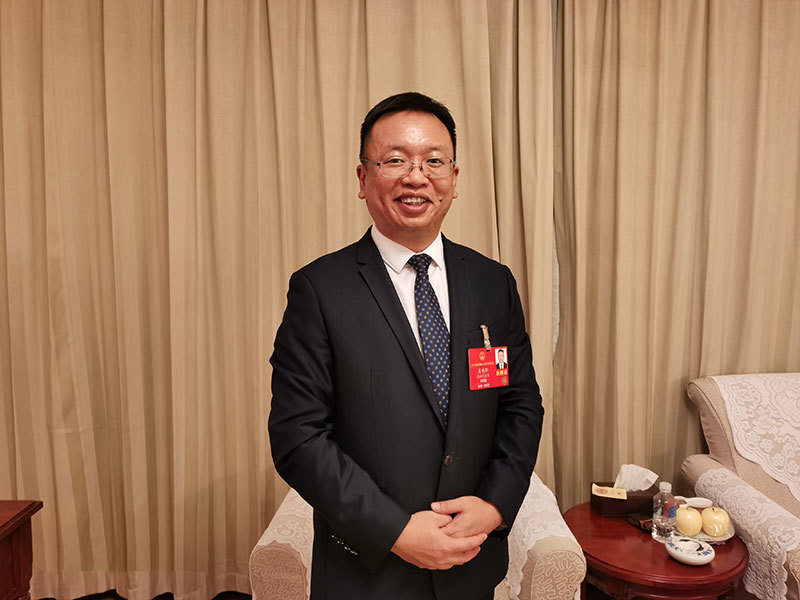
Nie Pengju, a representative of the National People's Congress and chairman of Coril, said in an exclusive interview with the Shanghai Securities News a few days ago that he has prepared 8 suggestions for the two sessions, 3 of which are related to the industry, including strengthening industrial support for the core components of industrial robots and reducing enterprises Income tax, the establishment of "Entrepreneur Day" to enhance entrepreneurship, etc.
Nie Pengju's view of performing his duties as a deputy to the National People's Congress is "making contributions based on his post and serving the society. In his view, deputies to the National people's Congress should make full use of their industry background and professional knowledge, conduct more research and think more, actively make suggestions and suggestions for the country's economic and social development, and convey the voice of the common people.
"With the continuous development of China's social economy, manufacturing labor costs are rising rapidly, and enterprises are in urgent need of transformation and upgrading. Industrial robots will become an important way to transform the manufacturing industry." Talking about the current situation of domestic manufacturing, Nie Pengju said.
"In the global industrial robot market, domestic enterprises only account for about 30% of the market, mainly low-end products, and about 70% of the high-end market is mainly occupied by the four leaders of Kuka, ABB, faranaco and An Chuan." Nie Pengju said frankly that compared with Japan and developed countries in Europe and the United States, my country's industrial robot industry has problems such as weak independent innovation capabilities, lack of core talents and core technologies, and serious control of mid-to-high-end core components.
According to him, the controller (control system), servo system (motor, driver, encoder) and precision reducer are the three core components with the greatest technical difficulty in industrial robots, accounting for about 70% of the cost of industrial robots.
"Core talents and key technologies are the biggest bottleneck restricting the development of industrial robots in China." Nie Pengju said that these three core components have high investment, long cycle, slow results, and relatively high thresholds. General companies cannot become bigger and stronger, and most of them are listed companies that are well-known in the industry. The key to improving the R & D and manufacturing level of domestic robots lies in improving the technology and quality level of the three core components.
Breakthrough in core technology is "key"
Nie Pengju's suggestion on the state's support for the core parts industry of industrial robots stems from his personal experience of leading Kolier to develop high-performance servo systems and achieve breakthroughs.
"It is suggested that the state should focus on supporting and cultivating benchmark innovation enterprises in the three core components industry of industrial robots, promote the development of the industry towards the middle and high end, and make the product technology and quality level reach or exceed the international advanced level." Nie Pengju wrote in the proposal.
"The biggest difficulty in developing high-performance servo systems is to form a research and development team." Nie Pengju said that for Kolil, mastering the core "heart" of various robots and precision equipment and breaking the monopoly of foreign technology is a choice full of hardships but no retreat. Corel began to develop servo motors in the second half of 2015, but because the key components such as encoders and drivers for servo motors come from abroad, many places are controlled by people.
In 2019, Nie Peng weightlifting new positioning research and development direction, to determine the development of the latest generation of servo motor, encoder, drive in one of the high-performance servo system. To this end, Nie Pengju and the personnel department tried every means to introduce a group of high-quality R & D personnel, formally established a R & D team in May of that year, and invested heavily in building a top domestic laboratory.
In the proposal submitted by the National Two Sessions, Nie Pengju suggested supporting the development of core innovative talents and key technology research and development of superior enterprises. Such as supporting enterprises to cooperate with universities and vocational schools to cultivate targeted high-quality industrial talents; jointly build R & D centers with universities and scientific research institutes, aiming at the international frontier and industrial development reality, and jointly research and develop and tackle key problems.
In terms of increasing capital and policy support, he suggested giving full play to the power of the capital market, such as supporting advantageous enterprises, venture capital institutions, scientific research institutes, etc. to prepare innovation funds or industrial venture capital funds, and encouraging innovative enterprises to be listed on the science and technology innovation board. "National industry associations and technical standards associations can be established to increase basic and forward-looking research on software and hardware technology and applications." Nie Pengju said.
Proposed "Entrepreneur Day"
"'Craftsman spirit' is the essence of entrepreneurship, and this spirit has new connotations in the new era." Nie Pengju suggested setting November 1 as "Entrepreneur Day" to promote entrepreneurship.
In his view, the most important point of entrepreneurship is patriotism and the spirit of fighting for national brands; the second is the spirit of responsibility for the enterprise, which provides both material and spiritual satisfaction for shareholders and employees on the basis of profit. At the same time, we must have a persistent spirit and continue to work hard based on the industry; in addition, when the company grows to a certain stage, it must give back to the society.
"In recent years, the state has vigorously promoted the reform of government institutions, streamlined administration and delegated powers, and built a new type of'pro-Qing' political-business relationship. The business environment of enterprises has improved a lot." Nie Pengju believes that under such a background, high precision is the direction of Chinese enterprises.
Kolier deep-cultivated motor industry research and development and manufacturing for nearly 30 years, has its own core technology, in the smart home segment motor industry in the domestic leading position. But when it comes to the future, Nie Pengju still says "just started".
"In the motion control motor industry, we have not entered for a long time, and we are still in the stage of rapid growth and development." Nie Pengju said. At present, the new generation of high-performance servo system successfully developed by Kolier has reached the level of Japanese and European enterprises in terms of performance, successfully breaking the monopoly of foreign enterprises on the high-end market.
According to his introduction, Kolier's motor products have expanded from the field of smart home to industrial robots, 3D printers, ATM machines, intelligent security, 5G base stations, 3C smart phones and other fields. The company has also established a division system within the company, using the "horse racing mechanism" to continuously develop new products.
Related references:
https://xhpfmapi.zhongguowangshi.com/vh512/share/9125732?channel=weixin&from=groupmessage&isappinstalled=0
Social Media